How U.S. Software Firms Can Expand Delivery Capacity Without Expanding Fixed Overhead

For many U.S. software firms, growth often stalls not due to weak demand, but because delivery capacity is constrained before the business is prepared to scale its internal team.
Even with a strong pipeline, capable leadership, and a solid client base, firms often face operational challenges: too many projects, insufficient specialized resources, and significant fixed overhead risk from rapid hiring. This creates a difficult balance for leadership. The company must grow while protecting margins, maintaining delivery quality, and avoiding a rigid cost structure that cannot adapt to project volatility.
As a result, many software firms are rethinking capacity expansion. Rather than relying solely on internal hiring, they are adding flexible delivery support through external engineering partnerships, which extend capability without permanently increasing payroll, bench costs, or management burden.
The Problem With Scaling Only Through Internal Hiring
Hiring is necessary, but it is not always the most efficient way to meet rising demand.
As software companies grow, they rarely need more developers in general. Instead, they require specific expertise at particular times, such as backend architecture, QA, integrations, ERP, mobile development, cloud support, AI implementation, or legacy modernization. Building all these capabilities internally is often slow and costly.
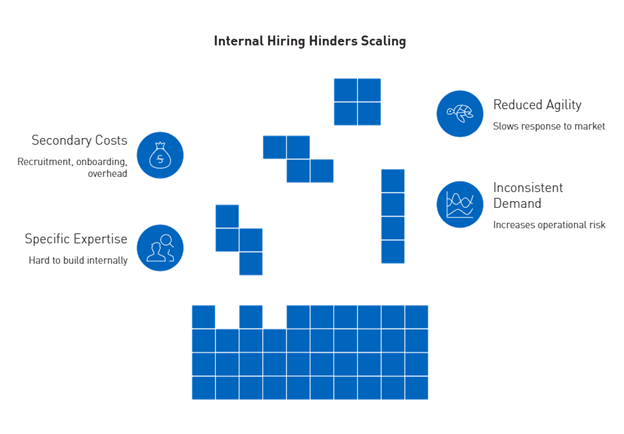
This challenge intensifies when project flow is inconsistent. A company may experience a quarter of high demand, followed by periods of shifting project timelines, slower contracts, or changing priorities. In such cases, each fixed hire increases operational risk.
Internal expansion also brings secondary costs that are often underestimated:
- recruitment time and cost
- onboarding delays
- management overhead
- lower utilization during slower periods
- quality risks when rushed hiring produces poor fit
- difficulty covering niche technical requirements across multiple projects
For firms in competitive markets, these constraints can reduce agility precisely when it is most needed.
Why Fixed Overhead Becomes a Strategic Constraint
For leadership teams, fixed overhead is not only a financial concern but also a growth constraint. Every permanent expansion decision impacts margins, delivery flexibility, and adaptability. Overbuilding internally can lead to underutilized, costly capacity, while underbuilding may result in missed revenue, delayed delivery, or overextended teams.
This tension is especially relevant for service-based software businesses, where profitability relies on balancing delivery capability and utilization. Losing this balance leads to hidden costs such as delayed launches, missed deadlines, employee burnout, rework, and lost opportunities.
For this reason, scalable firms increasingly view delivery capacity as something to be expanded in layers, not solely through permanent staffing.
A More Flexible Model for Growth
A more resilient approach combines internal leadership and client ownership with external delivery support that can be engaged as needed.
In this model, the software firm retains control over strategy, architecture, client relationships, and business oversight, while adding technical capacity through a trusted development partner. This enables the company to meet demand without tying each increment of growth to fixed overhead.
When used effectively, this approach helps software firms:
- mitigate hiring pressure
- access specialized technical capabilities faster
- reduce the risk of overloaded internal teams
- preserve delivery quality during growth periods
- support margin discipline by aligning cost more closely with project demand
This approach does not replace internal talent; it extends it intelligently.
Where External Delivery Support Creates the Most Value
Not every project requires external support, but certain situations clearly justify it.
One common scenario is specialized demand. A firm may have strong general engineering capacity but limited expertise in areas like ERP, advanced integrations, QA frameworks, embedded systems, or AI-enabled solutions. Building these capabilities internally for occasional needs is rarely efficient.
Another scenario is fluctuating project volume. Firms often win work in waves, and when multiple projects begin simultaneously, leaders must choose between delaying starts, rushed hiring, or overloading teams. Flexible support enables the business to absorb demand without compromising execution.
A third scenario involves margin protection. When project economics are tight, adding permanent costs can weaken profitability. A variable delivery model gives leaders greater control over cost alignment. In these situations, a structured technical partner can strengthen operations in practical ways.
What Software Firms Should Look for in a Delivery Partner
For U.S. software firms, the challenge is not just finding more developers, but securing a partner who operates with the discipline, communication quality, and technical depth required in a professional delivery environment.
A credible delivery partner should contribute across the full software lifecycle, including development, testing, integration, and support. The partner must also use structured delivery methods, transparent collaboration, and clear alignment with business requirements.
Software firms should also evaluate whether the partner can support a broad range Software firms should also assess whether the partner can support a broad range of technical needs. BRISA’s documented capabilities include web and mobile applications, embedded systems, GIS-based solutions, IoT integrations, automation, AI-related services, ERP implementation, and software testing, providing U.S. firms with access to expertise that may be difficult or costly to maintain in-house.
Brisa America’s Relevance in This Model
Brisa America is well positioned for this type of partnership because its value extends beyond coding capacity. Brisa’s documented strengths include tailored software development, systems integration, software testing, ERP expertise, AI-enabled solutions, and technical consulting, all supported by decades of experience and international project execution.
This is important because software firms need more than additional resources; they require reliable execution, adaptable technical support, and the ability to extend delivery capability without losing control or increasing unnecessary fixed costs. For firms seeking careful growth, the right partner can support a more scalable operating model.
Expanding Capacity Without Expanding Risk
The strongest software firms view growth not as a simple hiring exercise, but as an operating model decision. Expanding delivery capacity without increasing fixed overhead enables leadership teams to stay agile, protect profitability, and respond to demand with greater precision. It also allows pursuit of larger or more complex engagements without immediately increasing internal strain. For U.S. software firms facing rising demand, specialized project needs, or margin pressure, flexible delivery partnerships are becoming a strategic advantage rather than just a tactical option. Brisa America fits naturally into this model as a U.S.-facing company backed by experienced technical delivery, broad engineering capability, and a structure designed to help organizations scale with control.