Breaking the Code of Silence: How System Integration Eliminates Operational Silos
How much revenue is your organization losing simply because your internal systems refuse to talk to one another?
For many enterprises, the answer is a staggering figure hidden within the margins of inefficiency. Organizations consistently struggle with operational silos, disconnected systems, and fragmented data. When core platforms, such as Customer Relationship Management (CRM), Enterprise Resource Planning (ERP), and financial software, operate in isolation, the resulting inefficient workflows lead to duplicate work, delayed decision-making, and severely degraded customer and employee experiences.
System integration is rarely viewed correctly. It is often dismissed as a purely technical hurdle, a project relegated to the IT department to keep the lights on. In reality, system integrations are a fundamental business strategy for efficiency, scalability, and long-term viability. By architecting a unified data ecosystem, organizations can dismantle operational silos and unlock the true value of their technology investments.
The Hidden Toll of Operational Silos
When departments rely on disparate software solutions that do not communicate, the enterprise fractures. A sales team might close a deal in the CRM, but if that system is not integrated with the finance and fulfillment platforms, employees must manually transfer data. This manual intervention introduces human error, slows down the order-to-cash cycle, and frustrates both the workforce and the end customer.
Operational silos create blind spots, which keeps leaders from making accurate, data-driven decisions. If the CIO and operations leaders cannot trust the data because it is out of sync across platforms, the organization loses its agility. True digital transformation requires fluid data movement; without it, businesses remain anchored to reactive, rather than proactive, operations.
The Architecture of Connectivity: Technical Foundations
Modern system integration moves beyond the rigid, point-to-point connections of the past. Today’s strategies utilize dynamic architectures to support process automation and cross-departmental visibility. Understanding these technical elements is critical for IT managers tasked with unifying complex environments:
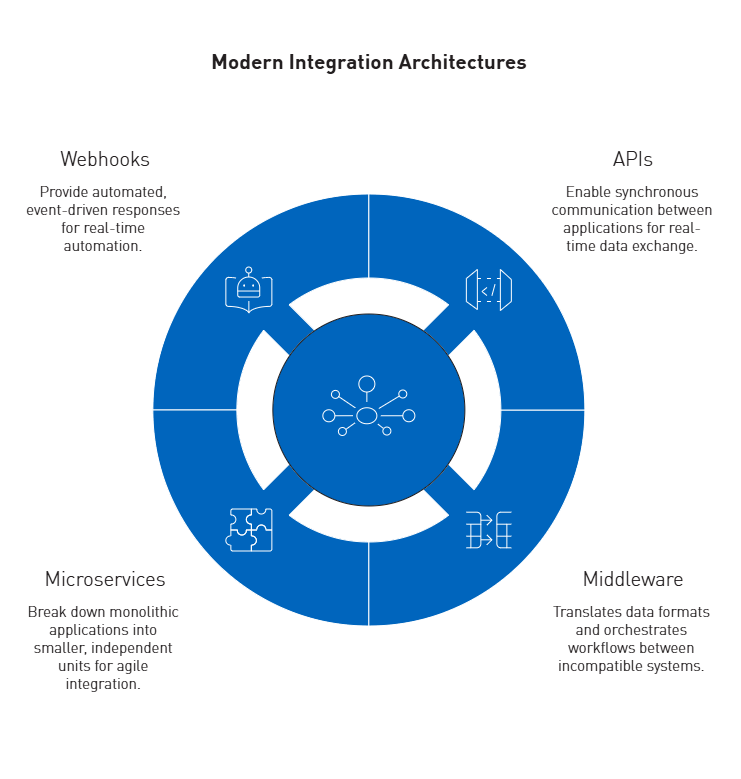
- Application Programming Interfaces (APIs): APIs are the standard building blocks of modern integrations. They allow distinct software applications to communicate synchronously, requesting and delivering data in real time. A well-documented API strategy enables enterprises to connect core platforms seamlessly.
- Middleware: When systems speak different data languages or operate on incompatible protocols, middleware acts as the universal translator. It sits between applications, orchestrating complex workflows, transforming data formats, and ensuring that information routes to the correct destination reliably.
- Microservices: Breaking monolithic applications into smaller, independent microservices allows organizations to update, scale, and integrate specific business functions without overhauling the entire system. This architecture inherently supports agile integration and rapid deployment.
- Webhooks: While APIs require a system to ask for data, webhooks provide automated, event-driven responses. When a specific action occurs in one system (e.g., a payment is processed), a webhook instantly pushes that information to another system, enabling real-time automation without consuming unnecessary server resources.
Navigating Legacy System Integration
One of the most significant hurdles business leaders face is the challenge of modernizing legacy systems. These older platforms often house mission-critical data and represent massive historical investments, making a “rip and replace” strategy operationally and financially unfeasible.
However, legacy systems do not have to remain isolated. Through strategic system integration, older infrastructure can be connected with newer, cloud-based platforms. This serves as a highly realistic and cost-effective modernization path. By utilizing API wrappers and specialized middleware, engineering teams can extract data from legacy mainframes and feed it into modern analytics or CRM tools.
This approach extends the lifespan of existing investments while granting the organization the agility of modern software ecosystems.
Prioritizing Security, Governance, and Compliance
Moving data freely across an organization introduces a new matrix of risks. System integrations cannot be discussed without placing a heavy emphasis on security, governance, and compliance. As data flows between an ERP, a CRM, and a proprietary database, it must be protected at every endpoint and in transit.
- Robust Security Protocols: Integrated systems require unified identity and access management (IAM). Implementing OAuth, end-to-end encryption, and strict role-based access controls ensures that only authorized personnel and applications can trigger data exchanges.
- Data Governance: Eliminating operational silos means establishing a single source of truth. Governance frameworks must dictate which system owns specific data fields, how data is formatted, and how conflicts are resolved when discrepancies arise between platforms.
- Regulatory Compliance: For U.S.-based firms dealing with healthcare or financial data, integrations must strictly adhere to frameworks like HIPAA, PCI-DSS, or SOC 2. Audit trails must be maintained across all integrated platforms to trace data lineage and prove compliance during regulatory reviews.
A Strategic Imperative for Scalability
System integration is not simply an IT initiative. It is a structural business decision that determines how efficiently information moves, how reliably teams operate, and how quickly leadership can respond to changing conditions. When critical platforms remain disconnected, organizations absorb the cost through duplicated effort, inconsistent data, delayed decisions, and limited operational visibility.
A well-designed integration strategy changes that condition. By connecting enterprise systems, standardizing data flows, and enabling secure automation, businesses can reduce friction across departments and create a more scalable operating model. Integrations also provide a practical path for modernizing legacy environments without unnecessary disruption, allowing companies to improve performance while preserving critical investments.
For organizations pursuing operational efficiency, stronger governance, and better decision-making, eliminating silos is no longer optional. It is a necessary step toward building a more connected and resilient enterprise.
If your organization is still operating across disconnected systems, manual workarounds, or fragmented data environments, now is the time to address it. BRISA America designs and implements secure, scalable integration solutions that connect core business platforms, support modernization initiatives, and align technology architecture with operational goals.
Contact BRISA America to evaluate your current integration landscape and identify the right path toward a unified, high-performance digital environment.